Signal is signal
Audio and control share one type. An LFO patches into a filter cutoff, a reverb mix, or straight into the speakers. An audio signal patches into a cutoff and becomes FM. There is nothing to convert.
Private beta, invites in waves
Patchbay is a live modular workshop. Patch modules together freely, play every control while it runs, and when a patch becomes something, export it as a real plugin you made. Not a patch player. Yours.
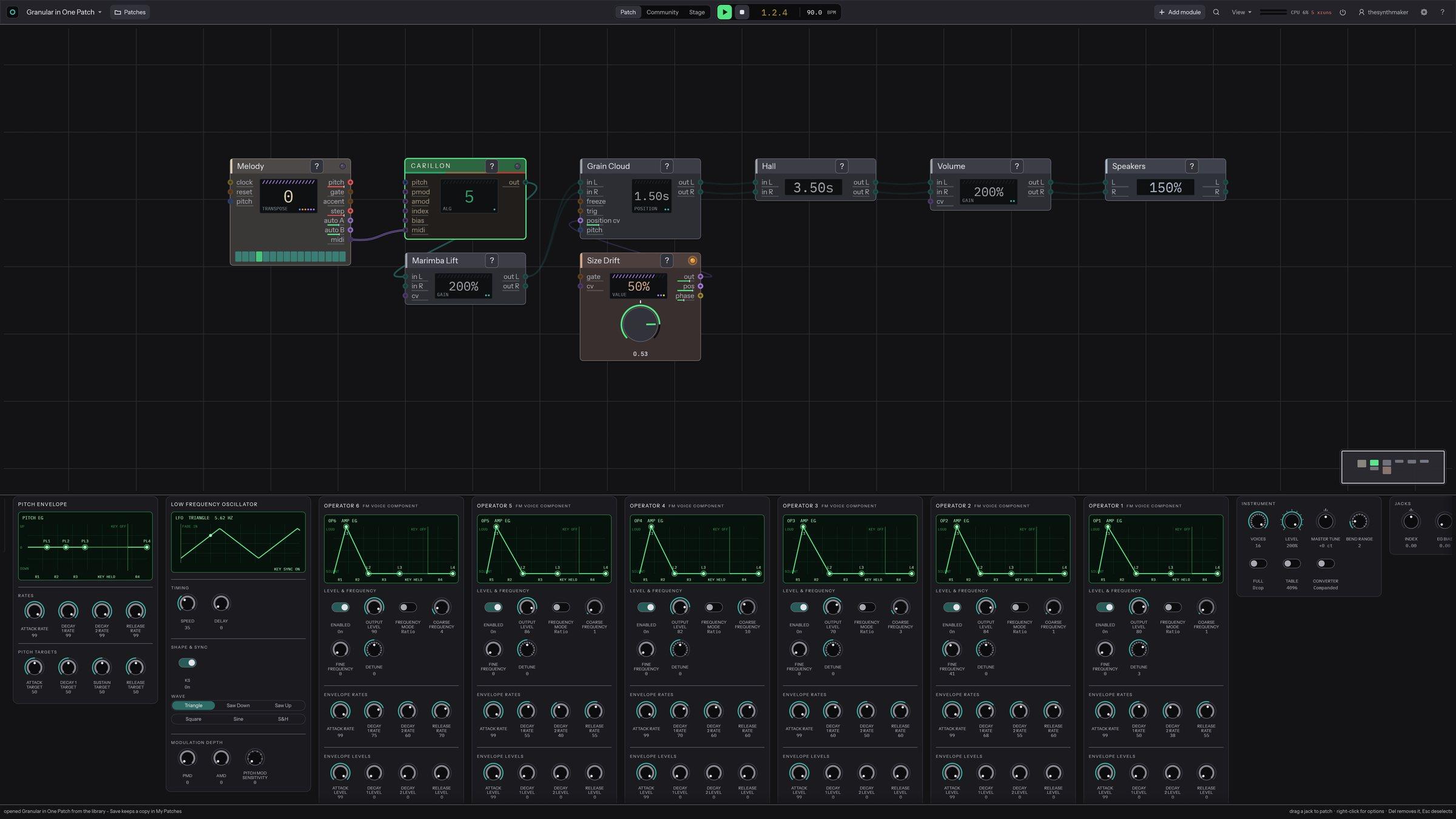
The workshop
There is no timeline, no arrangement view and no mixdown. The unit of work is a patch, not a song. The reference is a hardware ambient jam: a generative sequencer driving polysynths, everything landing in stereo delay and reverb, nobody arranging anything.
Audio and control share one type. An LFO patches into a filter cutoff, a reverb mix, or straight into the speakers. An audio signal patches into a cutoff and becomes FM. There is nothing to convert.
A MIDI controller is a module whose messages are outputs. So is a hardware audio input. They patch into anything, exactly as an LFO does.
Select some modules and group them, and they become one box with the jacks that crossed its edge and the knobs you chose to show. Double-click, and it opens back up.
Authenticity is the floor, not the ceiling. A 1957 plate in the feedback path of a 2018 stochastic sequencer. A 12-bit sampler's converters on a bowed string. Model it exactly, then open it up.
Reality
Most modular tools end at the patch: to hear it anywhere else you load the whole workshop and point it at a file. Reality is the other way round. When a patch has become an instrument, it leaves Patchbay as a plugin of its own, with your controls on the front, your wiring inside, and nothing else along for the ride.
It is the thing you built, as a thing, in the place you make music. Give it to a friend. Keep it for a decade. It stays yours either way.
Your front panel
Only the knobs you chose to show, named as you named them.
Your wiring
The patch runs inside exactly as it ran on the bench.
Your file
Open, readable, and yours to share or keep.
For builders
The person at the other end of this is not an audience. Everything is arranged so they can get at it.
An emulation's parts are modules on the bench. A block opens with a double-click. Locking is opt-in and asks twice, because the normal state of a thing here is open.
Patches, blocks and instruments are files you can read, diff and send to someone. The library is yours and stays on your machine.
Every module models how the original actually works, circuit and mechanism, and then gains the jacks the original never had. Where something is not modelled, the docs say so.
Runs natively on both, with every control playable by hand while the audio runs. Nothing stops the sound to ask a question.
Private beta
We are inviting testers in waves, builders first. Leave your email and tell us a little about where you make things, and we will write when your wave opens.